Geometry

The Geometry of Numbers

At Stanford OHS, advanced mathematics is not a set of formulas to memorize—it is a living conversation. Our courses invite students to explore open-ended questions, construct examples and counterexamples, and engage in proof writing that develops deep, first-principles understanding. Students learn to think like mathematicians: to conjecture, test, revise, and communicate ideas clearly to peers.

In Geometry of Numbers, students investigate the geometric and number theoretic structures of the lattice plane—the array of integer points (x, y) ∈ Z2—and discover the surprising ways that algebra and geometry intertwine. Beginning with questions that are simple to pose but rich to pursue, the class develops tools from number theory, linear algebra, graph theory, and abstract algebra to prove deep results. Along the way, students meet landmark theorems (Pick, Blichfeldt, Minkowski), study the algebraic structure of lattice transformations, and discover and prove a necessary and sufficient condition for existence of a regular lattice n-gon. Through carefully scaffolded questions and ideas, students arrive at open research directions, including connections to the Riemann Hypothesis, advances in Ehrhart theory, and the study of lattice polytopes in higher dimensions.

During this one-semester course, each student builds a research portfolio of original proofs, constructions, and reflections. Students complete the course with advanced experience reading and writing mathematical proofs, cross-disciplinary insight, and the confidence to approach open problems. They are prepared not only to succeed in advanced university mathematics, but to participate meaningfully in it.
Latin

Latin Prose & Poetry

Most advanced Latin courses have students reading from editions made by scholars. Stanford OHS’s capstone Latin seminar has students making new editions entirely. 

In this course, students use the accumulated knowledge of their previous three years of language study to create a new edition of these texts, with a glossary and grammatical commentary, for future students as part of Pixelia Publishing’s open access educational texts. 

By working on previously unavailable texts, students are not only expanding their own mastery of Latin but are also expanding the available corpus of Latin language texts for future Latin students. One ongoing project, for example, is Pixelia’s Experrecta Series of Women Latin Authors

Students of this year’s Latin capstone seminar are hard at work on creating the upcoming Anthology of Letters from Women in Ancient Rome, including everything from notes on the letters’ authors to placement of macrons in the texts.

Michael Gonzales

Revolutions & Rebellions

What’s unique about studying history at Stanford OHS? Our history courses emphasize the act of interpreting the past, inviting students to develop skills and habits of thought that enable them to examine and make sense of human and social complexity over time. 

The first high school history course for many Stanford OHS students is Revolutions and Rebellions, which focuses on three interconnected, transformative moments in the Atlantic World: the American, French, and Haitian Revolutions. How exactly were these three events connected? Students in Revolutions and Rebellions answer this question by considering how revolutionary activity can come from many directions at once. 

As Dr. Michael Gonzales, Division Head of Humanities, explains: “There is tension between revolutionary leaders and groups or individuals, including those once marginalized, who use revolutionary language, ideas, and energy to other ends.” A revolutionary crisis can lead to unpredictable and surprising results. 

Students complete Revolutions and Rebellions with an understanding that historical change is never open to simple explanations but that they can acquire the skills and knowledge to interpret history in compelling and meaningful ways.

Joe Polacco Class

Object Oriented Programming & Design

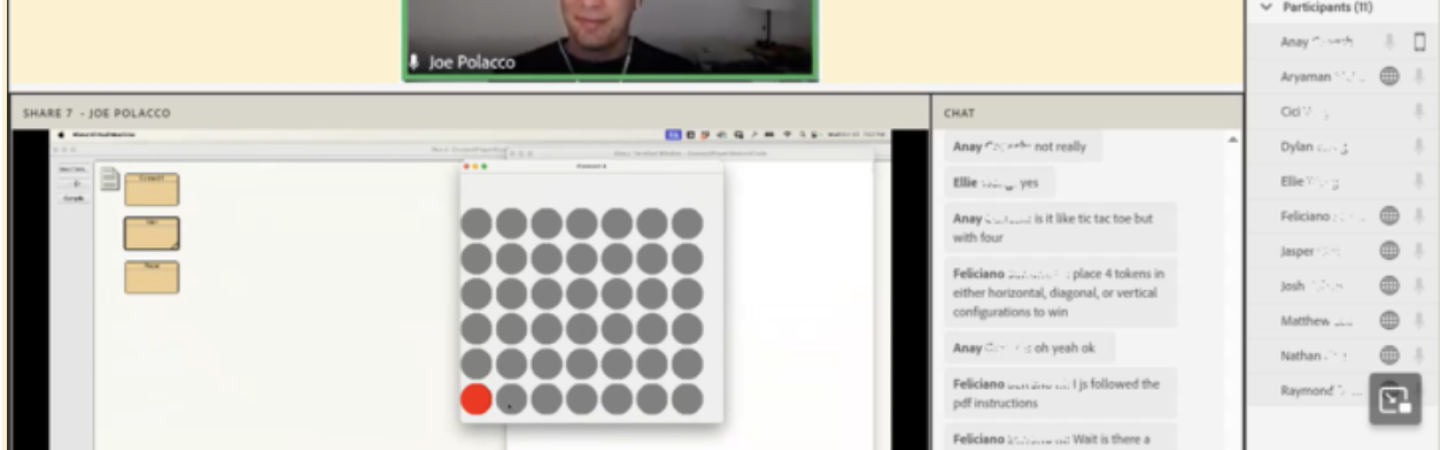
Object Oriented Programming & Design takes an interdisciplinary approach to computer science, guiding Stanford OHS students to learn how computation can be and is applied across diverse fields of study. Along the way, students gain a practical understanding of how coding might fit into their career paths. The course focuses on problem solving, computational thinking, design, logic, and creativity. 

Over the course of the final semester, students design and complete a major project in a field or area of personal interest. Projects are required to implement a graphical user interface rather than a purely text-based design. Below are just a few examples of the hundreds of final projects that Stanford OHS students have completed over the years (all coded in Java).

  • A 2-D simulation of Schelling's Model of Segregation: how individuals might self-segregate, even when they have no explicit desire to do so
  • A computational model of a famous physics experiment that observes how particles move in a liquid due to Brownian motion, applies Einstein’s model to the data, and calculates an estimate of Avogadro’s number
  • Mapping COVID-19 infection and mortality data on a world map
  • A melody and music generator
  • 2-D game implementations: minesweeper, asteroids, sudoku solver, chess
  • A stock market simulation
  • A flight simulator
  • Design of a simple, interpreted programming language
  • Mountain pathfinding: analyzing a topographical map to find best routes.
Data Science

Data Science

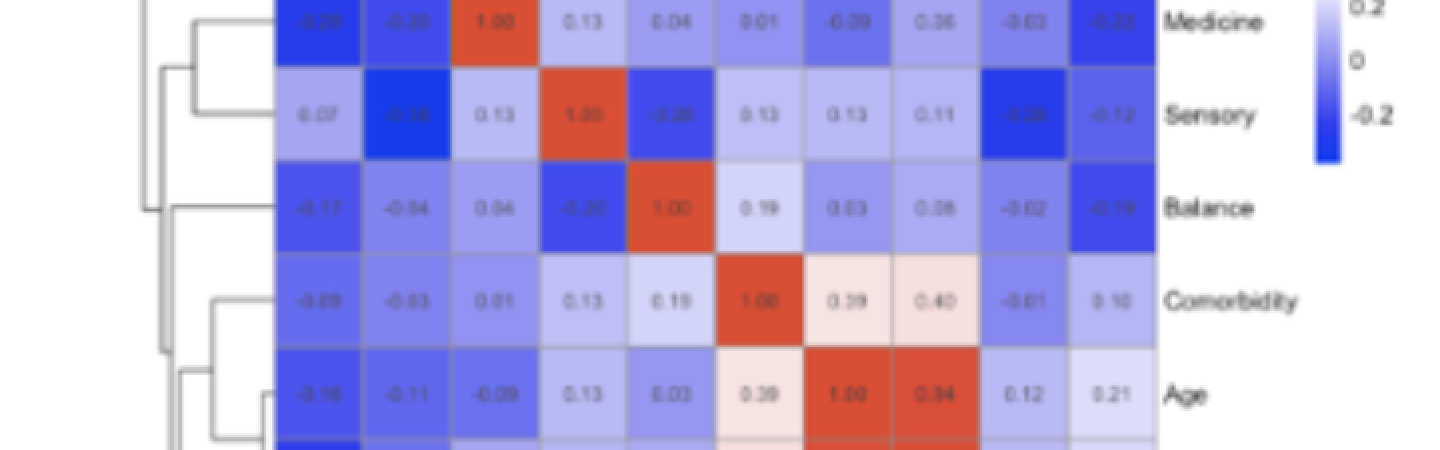
In a world in which it is possible to amass large quantities of data, it becomes necessary to have tools that separate the signal from the noise. In Data Science, students are introduced to a variety of algorithms and statistical models to evaluate datasets using the programming language R. 

Evaluating a dataset involves formulating the right research question and assessing the qualities of the dataset that lend themselves to different statistical models, including non-linear regression, Bayesian analysis, and random forests. Students learn these skills at a fundamental level in addition to trying them out in the real world with a capstone project of their own design. 

Through this project, students have pursued topics they are passionate about such as stock market predictions, emotional reactions to artwork, cancer diagnosis, and more.

Constitutional Law

Legal Studies - Constitutional Law

Stanford OHS alums often cite the Constitutional Law final as a formative experience. Students start the year studying civil rights as they pertain to youth, separations of powers under the U.S. Constitution, and free speech under the First Amendment. Along the way, they learn to read case law and write case briefs. The spring shifts to extended study of a single legal controversy, one the students themselves have chosen from the U.S. Supreme Court’s current docket of cases. 

Having reviewed controlling laws, delved into the facts of the case and worked through the issues – both legal and social – they finish the year with oral argument before a panel of mock Justices from the Stanford OHS community, including instructors and staff, parents in the legal field and Legal-Studies alums who have returned as judges. 

As happens with real-world appellate advocacy, the judges demand answers of each student advocate, drawing out decisive lines of analysis.

Quantum Computing

Introduction to Quantum Computing

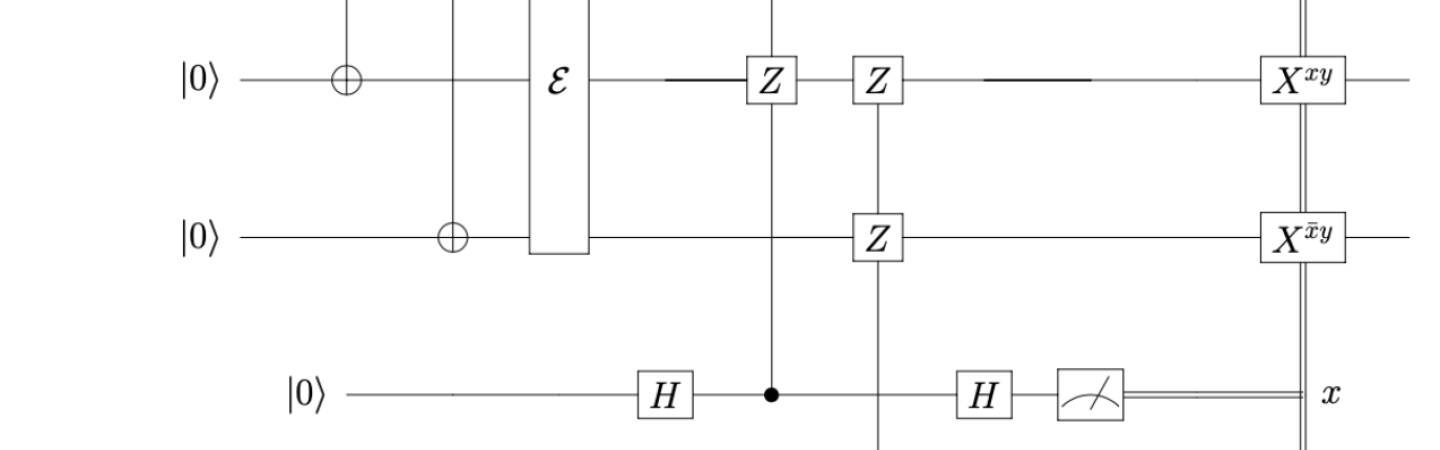
Introduction to Quantum Computing is a two-semester course at Stanford OHS that covers various areas related to harnessing quantum mechanics to improve the efficiency of certain types of computation. 

What is quantum computing?

It was only in the 1980s that Richard Feynman suggested that to simulate quantum systems efficiently a new paradigm of computation was required that is inherently quantum mechanical. The most elementary way to describe quantum computation is the replacement in classical (non-quantum) computing theory with quantum objects having two possible outcomes when measured -a qubit. A classical bit has only two allowable states in which it can be in, 0 or 1. A qubit has two outcomes when measured, again 0 or 1, however a qubit can be in an infinite number of quantum states prior to measurement. 

A typical quantum algorithm involves manipulating (without measuring) a set of qubits such that the probability for the 'correct' answer is amplified while diminishing incorrect ones. 

One goal of the course is to examine various statements about quantum computation and determine what is hype (or incorrect) and what are valid explanations. It is commonly stated that quantum computing is powerful because it calculates all possible inputs simultaneously. This is incorrect! Quantum computation does not permit calculation of problems not possible with classical computers; it is about making particular algorithms significantly more efficient to calculate. 

In fact, the range of problems for which a quantum computer is thought to be more efficient is rather narrow. However, known theoretical results (e.g. Shor's prime factorization algorithm) would have a large impact on security and data encryption. 

Each semester, students explore a topic of their choosing in more depth, with some students programming on IBM's Qiskit platform, which permits small computations on an actual (though limited) quantum computer.

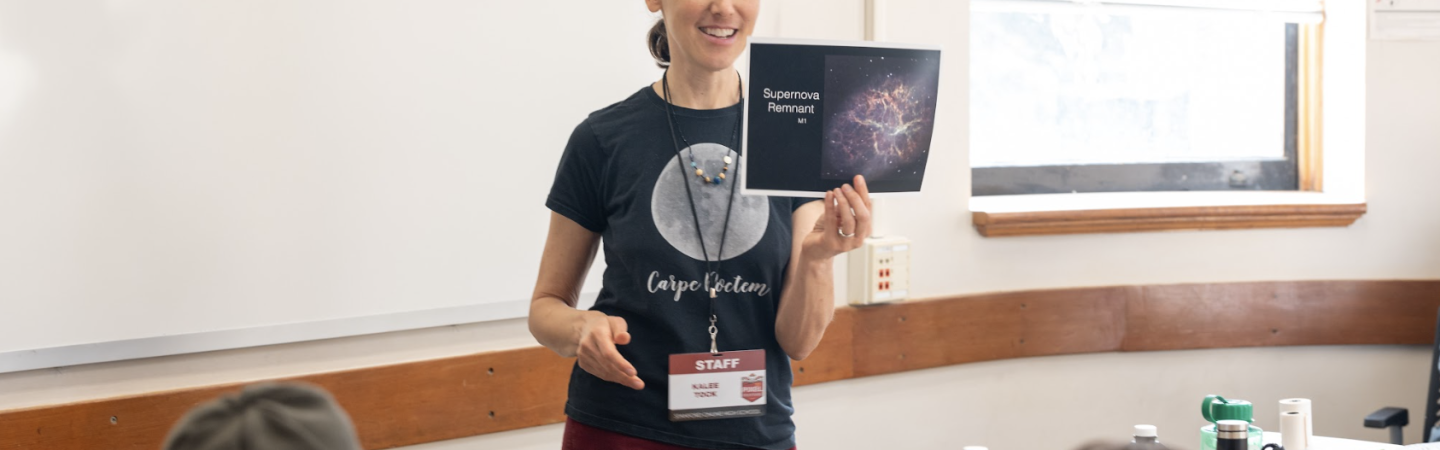
Instructor Kalee

Life in the Cosmos

Life in the Cosmos is an interdisciplinary course that explores the question of what life will look like beyond planet Earth. The topic is considered both from the perspective of human life in the cosmos (i.e. manned space exploration and the far future) and extraterrestrial life that may have arisen on other planets. 

Students are encouraged to think creatively and broaden their horizons through novels and film. But this is also a course with serious scientific underpinnings. Class activities and labs include observing with telescopes, designing Mars habitats (and thinking through some of the challenges that will be associated with living in them), and participating in citizen science campaigns like the NASA Exoplanet Watch Initiative. 

Students also evaluate the feasibility/desirability of sending missions to various moons in our solar system, and consider the scope of the threat posed by asteroids and how to prepare for a potential strike. All the while, students think through the ethical issues associated with potential disruption of extraterrestrial environments by our exploration of them.

"This image is an example of analysis that Life in the Cosmos students contribute to NASA Exoplanet Watch, showing a dip in the light of a host star when an exoplanet passes in front of it along Earth's line of sight," said Kalee Tock, Science Instructor. 

20th Logo Banner wide

This year, Stanford OHS will celebrate 20 years as an online school!